GABRIELA PINHEIRO
Back to home
Stone
·
2026
From Discovery to Launch: Stone Benefits Program
Product design
Research
Metrics
A/B test
Fake door
Problem
User research and feedback from Stone's Customer Relations team revealed a demand for benefits that would reward customer loyalty. In 2025, this opportunity became a strategic initiative.
The challenge was to create a program that increased the perceived value for business customers (SMBs), contributing to:
Increased TPV (payment volume processed through Stone's payment terminals)
Increased account primacy (encouraging customers to keep their funds with Stone)
Increased adoption of banking products
Reduced churn in the medium and long term
Competitive differentiation in a market with few benefits programs for SMBs
Strategy Definition
Our main challenge was to launch the Benefits Program within 12 months for 30,000 customers. To achieve this, we established an execution cadence and continuous alignment across Engineering, Product, Pricing, and Business teams.
I led the experience discovery, conducting research and experiments to reduce uncertainty and guide strategic decisions throughout the development process.
Q1: Definition of the program mechanics (points, tiers, or goal-based rewards)
Q2: Concept validation
Q3: Experience, content, and interface refinement
Q4: Launch for 30,000 customers and results monitoring
Q1: Defining the Program Mechanics
I conducted benchmarks of benefits programs and facilitated ideation workshops to explore different mechanics: points, tiers, and a hybrid model. We then validated these concepts with customers through interviews and prototype testing.
The results, combined with insights from Data and Engineering, led to the selection of a points-based program, as it provided a clearer relationship between customer behavior and rewards. This approach also offered greater flexibility to serve different customer profiles and to evolve the program over time with new missions, benefits, and products.
The points-based model also provided more room for experimentation.


Onboarding for the three tested mechanics: Points, Levels, and Hybrid.
Q2: Concept Definition
In this quarter, we focused on defining which missions and benefits should be included in the program's V1 and how they should be presented to customers. To achieve this, we combined customer interviews, experiments (A/B test, fake door + quantitative survey), and business metrics analysis.
Learnings
The research showed that financial benefits, such as higher returns on the Reserve balance and temporary fee discounts, were perceived as the most valuable by customers. We also found that small behavioral changes were easier to encourage than ambitious goals, and that a lighter, more positive communication style increased the perceived value of the program. Benefits aimed at individuals were deprioritized because they competed directly with well-established consumer loyalty programs.
Decisions
By combining these insights with impact and effort analyses, we prioritized the first version of the program to encourage the adoption of Stone's strategic products, such as increasing TPV, paying bills, using Pix, maintaining a Reserve balance, and using the credit card.
We decided that the program's success would be measured by its ability to drive the adoption of these products.


Fake door linking to a signup form.
Q3: Refinement
With the key learnings validated, we refined the experience, conducted usability testing, and defined the scope of V1 in partnership with Product, Engineering, and Pricing. While development progressed, we used the test findings to refine the experience and prioritize deliveries for the launch.
Onboarding & home
The onboarding flow formalized users' opt-in to the program. Through an A/B test, we evaluated whether an initial reward increased activation. The home screen prioritized the features that delivered the most value to customers: point balance, missions, and available benefits.


Onboarding, recognition modal, and program home screen.
Missions
The missions were designed with a lighter visual language and celebrated customers' achievements, reinforcing the behaviors we wanted to encourage. To meet the V1 deadline, we simplified parts of the experience and postponed personalization features for future iterations.

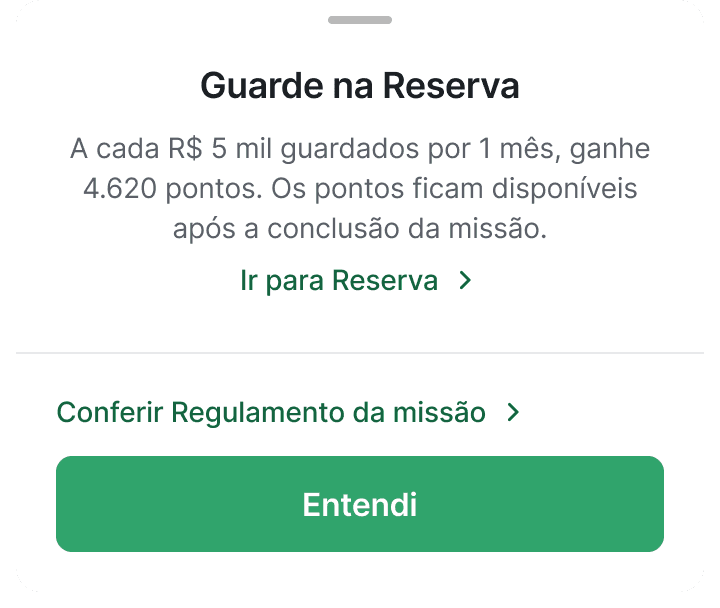

Missions, mission details, and celebration modals.
Benefits
Some technical constraints required us to simplify parts of the V1 experience. We chose a functional solution to ensure the launch stayed on schedule, while prioritizing personalization improvements for the roadmap.


Benefits, benefit details, and redemption success feedback.
Q4: Launch & Monitoring
The Benefits Program was gradually launched in December 2025 and reached 50,000 customers, exceeding the initial target of 30,000. After the launch, I monitored the product's performance through Amplitude analysis, customer interviews, and regular reviews with the Product, Engineering, and Pricing teams.
In the first few weeks, we observed positive engagement signals: customers who completed missions accessed the program 2x more, while those who redeemed benefits returned 2.5x more.
Customer interviews revealed that participants perceived the program in an emotional, rather than transactional or purely mathematical, way. It was seen as a symbol of Stone's partnership with their businesses.
Results after 3 months
The program was launched to 50,000 customers (initial target: 30,000).
Increased adoption of bill payments and credit card usage among participants (requiring further monitoring to validate long-term consistency).
30% increase in the average balance maintained in the Reserve.
Participating customers generated, on average, R$ 62 more revenue for Stone than customers who did not use the program.
End of Benefits Program
Although the program showed positive adoption signals, it was discontinued after three months following a company-wide strategic shift, including a pricing redesign and executive leadership changes.
The learnings from the program informed subsequent initiatives in 2026, including a new mechanism for reducing payment terminal fees for customers.
2026 Gabriela Pinheiro
Curitiba, Brasil